AI tests already exist. You just can't run them on every PR.
Plain-English testing isn’t new. What’s different about Sedum is the economics: it’s open source, built on Jev, so running the whole suite on every PR costs dollars a month instead of thousands.
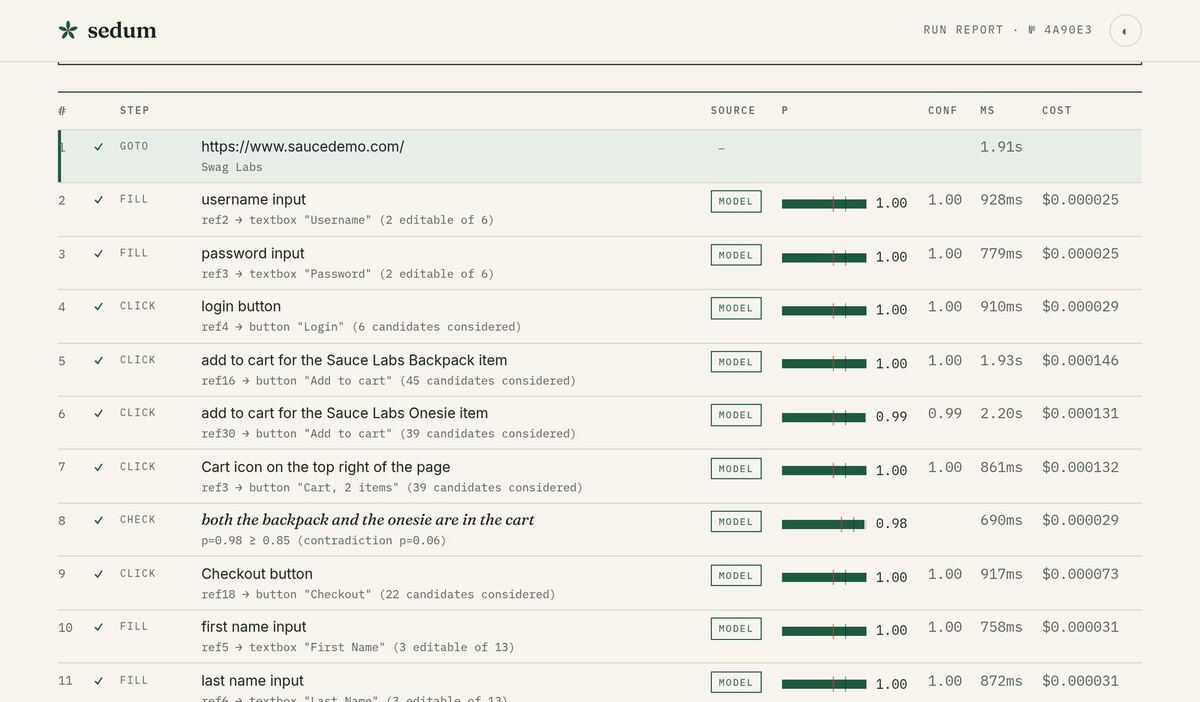
Six things about testing with AI.
Writing tests in English is a good idea. Somebody already had it.
It works, and people use it. We're not going to pretend we invented it.
A test you run twice a week isn't a safety net.
You want every test on every pull request. That's where the pricing breaks: these tools charge per step, and a modest suite blows through the plan.
Cheap has to mean cheap at volume.
Jev is fast and cheap enough to ask on every step of every run. That changes how many tests you can afford to write, and how often you can afford to run them.
Open source. No black box between your tests and the verdict.
The prompts, the scoring and the cache are all in the repo, so you can see what goes to the model and what comes back. It runs on your own model key, on your own machine.
A pass at 60% isn't a pass at 99%.
Every check comes back as a probability measured against a threshold you set, plus a second question: does the page contradict the claim? High on both is marginal, never a pass.
If the page moved, the report should say so.
When a cached element stops resolving, Sedum finds it again and keeps going,
then grades the run DIVERGED instead of green. The test passing and
the product changing are different facts.
What a 20-person team's PR suite costs.
About a dozen engineers, one pull request a day each, pushed twice: roughly 20 runs of every test. Fifty tests, ten steps each, three of them AI steps. Priced per step, then on Jev.
Per-step platforms
Sedum
Fast enough to ask on every step.
A model call per step sounds slow. On Jev it's under half a second, so a 17-step checkout finishes in 14 seconds. The same flow takes 69 on a per-step platform.
Per-step platforms
Sedum
You write the sentence. Sedum finds the button.
A test is a short list of plain-English steps, with no selectors. When a test needs more, write it in TypeScript and put Playwright, test data and your own helpers between the same sentences.
Same four sentences in both formats. Switch to TypeScript to see a Playwright check between them. The scores shown are an example.
Four buttons say Buy. Only one is on the blue card.
In the page's text those buttons are identical, so no text model can tell which one you meant. When a click is that ambiguous, Sedum numbers every candidate on a screenshot and lets a Vision LLM like Gemini Flash point at the right one. It picks from buttons Sedum already found, never invents one.
Changed the cart? Sedum skips the login tests.
Add --affected and Sedum scores each
test by how related it is to your change. Cart and checkout tests run. Login, search and
footer tests are skipped, and the list shows you which.
Sends your Git diff and test files to Jev, which scores how relevant they are. Keep running the full suite in CI.
$ sedum run --affected
Affected selection: 5/9 tests, threshold 0.1, base main.
RUN  0.9412 "tests/cart/add-to-cart.test.yaml" (model)
RUN  0.8731 "tests/checkout/guest.test.yaml" (model)
RUN  0.6120 "tests/checkout/saved-card.test.yaml" (model)
RUN  0.1840 "tests/account/orders.test.yaml" (model)
RUN  0.0310 "tests/account/address.test.yaml" (test-or-module-changed)
SKIP 0.0620 "tests/account/profile.test.yaml" (model)
SKIP 0.0210 "tests/search/filters.test.yaml" (model)
SKIP 0.0045 "tests/docs/footer.test.yaml" (model)
SKIP 0.0012 "tests/auth/login.test.yaml" (model)
RUN / SKIPWhether this test runs on this branch.0.8731How related the test is to your change, from 0 (unrelated) to 1 (clearly related). 0.1 or higher runs.(test-or-module-changed)You edited this test or a step it uses, so it runs whatever its score.Try it today, or keep an eye on it.
Open source. Runs on your CI.
Install it, point it at your app, write a sentence.
View on GitHub → Read the docs →One email per release.
New features, benchmarks, what’s next. No drip campaign.
Your address, and nothing else. Unsubscribe is a reply.
Why “Sedum”? It is the plant they put on green roofs: gravel, full sun, nobody up there with a watering can. It lives anyway. We wanted an e2e testing suite that works the same way, so we took the name and the habits with it.